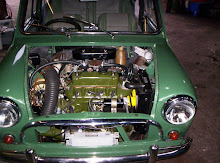
When the Austin Seven and Morris Mini-Minor were introduced in 1959, after eight years of design and development, they caused a sensation in the motoring world for the new B.M.C. Minis bristled with unconventional ideas, but were nevertheless essentially practical in conception. Soon the original Austin and Morris Minis were joined by the Wolseley Hornet and the Riley Elf, together with the redoubtable Cooper and Cooper "S" versions which immediately established themselves as giant-killers in the racing and competition worlds.
In October 1967 came the Mini "1000" Mark II models, with 998 c.c. engines, and in October 1969, ten years and two million Minis after the introduction of the original cars, the more refined and comfortable Clubman and 1275 GT models. These were followed, in November 1969, by two new "basic" Minis—the 850 and the 1000—which retained the old bodyshell but incorporated the wind-up windows, concealed hinges and the negative-earth electric system of the Clubman.
The Mini 850, 1000, Clubman, Clubman Estate, 1275 GT and the Cooper "S" therefore comprised the complete Mini range, the Austin, Morris, Wolseley and Riley variants being discontinued and the cars being known simply as Minis in their own right.
To what do the Minis owe their astonishing success? It was their designer, Alec Issigonis, who best summed it up when he remarked, in effect, "We have deliberately made the cars very small outside, because we have found new ways of making them very large inside."
How was this done, and how does it affect the owner who proposes to carry out as much maintenance as possible in the home garage? First, there is the arrangement of the combined engine and transmission unit transversely across the front of the car. Besides saving a great deal of space, this has rendered all the usual items that require attention (except possibly the ignition distributor) unusually accessible; the owner should have no difficulty in carrying out normal adjustments and all work short of a major overhaul (which calls for removal of the engine).
Admittedly the ignition equipment, being mounted at the front of the engine without protection from a radiator, is liable, on earlier models, to be swamped by a bow wave if a water-splash is negotiated too enthusiastically, and cutting-out of the ignition can also occur when driving in heavy rain. Simple methods of waterproofing the ignition system are, however, discussed in Chapter 7. The engine and transmission assembly share a common supply of oil. Instead of having to check and top-up three oil levels, the work is confined to checking the level on the usual engine dipstick and adding fresh oil through the filler on the valve cover. A similar saving in time and trouble applies, of course, when it is necessary to drain the oil.
Notice, also, that air is forced through the side-mounted radiator from the engine side, emerging by way of the nearside wheel arch, which means that the engine is not surrounded by preheated air .The technically-minded reader will appreciate that this might lead to carburettor icing in cold weather but will note that this can be taken care of, on most models, by positioning the inlet to the air cleaner close to the exhaust manifold. A pre-heated air intake does, of course, result in the loss of a small amount of power under full-throttle conditions, but this is more than compensated for by improved flexibility and better fuel consumption over a wide range of running conditions and in hot weather the intake can be swung away from the manifold.
Again there is evidence of the combination of technical and practical considerations in the use of hollow rubber cones as suspension units instead of steel coil or leaf springs. Rubber springs not only have excellent self-damping properties, giving a particularly good "ride," but require no lubrication and cannot develop squeaks or broken leaves! The Hydro-lastic suspension fitted to later cars, which is described in Chapter 9, takes the principle a stage further by interconnecting the front and rear suspension units, giving a level, pitch-free ride that is outstanding for such a small vehicle.
One could continue to point out examples of the way in which technical advantages have been combined with practical features throughout the car. It is necessary, however, to turn now to a brief description of the functioning of the various instruments and controls, followed by notes on the handling characteristics of the various models. The information is intended mainly for the benefit of an owner who is anxious to get the best from his car; it does not come into the category of elementary driving instruction, as this is a subject which is obviously the province of a fully-qualified instructor.
Sunday, 18 October 2009
Getting to know your car
Labels: car, cooper, equipment, getting, know, mini, radiator, suspansion, transmission, waterproofing
Posted by Info Mini Cars at 04:52 0 comments
Lubrication Equipment
Only two further items are necessary when lubrication is carried out at home. If an inspection pit is not available, a pair of wheel ramps will be required to provide adequate clearance for lubricating the front suspension, steering and the drive shafts, handbrake cables, draining the sump, and, incidentally, servicing the petrol pump.
Although the ordinary type of grease gun is quite efficient the side-lever type of gun is to be preferred. It enables a very high pressure to be developed with little effort, and has also the advantage of being fitted with a long extension tube, which makes it easy to reach less accessible points, and a snap-on hydraulic connector which provides a perfect seal without the need for applying pressure against the nipples.
These items will render the owner virtually independent of a service station, and their cost will probably be more than recovered during the first few months of home servicing.
A large-scale lubrication chart, printed on stout paper and suitable for hanging on the garage wall, is always an asset. It is worth recording that such charts, covering a very wide range of cars and models in addition to those covered by this book, can be obtained free of charge from the Castrol Chart Library, Castrol House, Marylebone Road, London, N.W.I.
Labels: chart, equipment, grease, gun, lubrication, pump
Posted by Info Mini Cars at 04:27 0 comments
Workbench and Storage
A workbench will be needed for any jobs that are not done in situ on the car, but is by no means essential if the work is confined to simple routine servicing and adjustments. It is quite possible to make do with a stout kitchen table, which can often be picked up for a few shillings at an auction.
Again, if any but elementary servicing is carried out, it will be necessary to obtain an engineer's vice, which should be securely bolted to the bench, reinforcing the top, if necessary, at this point. Excellent vices can often be obtained quite cheaply from stores dealing in Ministry surplus equipment.
Shelves can be fitted beneath the bench or to the wall, to accommodate the inevitable collection of tins, jars and bits and pieces that will accumu¬late from time to time. Small steel parts can be kept in jam jars filled with a fifty-fifty mixture of paraffin and engine oil, to protect them from rust. A wooden stand can also be made up to take a 5-gallon drum of oil as it is much more economical to purchase oil in bulk than in pint, quart or gallon tins. A draw-off tap can be purchased quite cheaply to replace the screwed plug in the side of the drum. Needless to say, when fitting the tap the drum should be laid on its side, with the screwed plug uppermost.
Labels: equipment, mini car care, storage, surplus, workbench
Posted by Info Mini Cars at 04:27 0 comments
Tools and Equipment
No job can be done properly if the correct tools are not available. Unfortunately, manufacturers of popular cars seldom include any but the bare minimum of items in the tool kit and it will therefore be necessary to purchase one or two items to supplement the selection of screwdrivers, pliers and so forth that the average home handyman will usually have accumulated over a period of years.
Spanners are particularly important, if any but the most elementary servicing is to be done. It must be remembered that "Unified" screw threads are standardized on these models and that nuts and bolts of this type call for the use of American spanner sizes (usually termed S.A.E. spanners). If you have a legacy of Whitworth spanners from an earliercar, do not be tempted to use them on Unified nuts. They may appear to be a reasonably good fit but there is a risk of damaging the corners of the hexagons if any stress is applied. It will be necessary to purchase a set of good-quality double-ended spanners in a range of sizes from, say TV in. to
in. A/F ("across the flats"), which will fit Unified nuts in sizes from i in. to & in.
Ring spanners are to be preferred, although one or two slim-jawed open-ended spanners may be required for the occasional awkwardly-placed nut. Better still is a set of socket spanners. If these are provided with an extension drive and, possibly, a ratchet handle, so much the better.
A medium-sized adjustable spanner will often come in handy but it should be used for holding, rather than turning, nuts and bolts. Always use a proper spanner whenever possible.
Before leaving the subject of spanners it should be mentioned that a B.S.F. nut should not be forced on to a Unified thread or vice versa. When buying replacements, make sure that these are of the Unified type; if these are not available, American National Fine (A.N.F.) threads are interchangeable, for all practical purposes, with Unified threads.
Next and equally important comes a set of feeler gauges. The small plug-gap and contact-breaker feelers provided in the tool kit may serve in an emergency but a combination set of feelers, which can be purchased quite cheaply from most accessory houses, enable adjustments to be carried out more accurately and more conveniently. A set of feelers is, in any case, essential when adjusting the valve rocker clearances. For the sparking plugs, however, wire-type gauges are preferable. These can be obtained in sets which incorporate a gap-setting tool which eliminates any risk of damaging the sparking plug electrodes, as described in.
A good tyre-pressure gauge is also a worthwhile investment, as it is seldom wise to rely on pressure gauges used by garages. In the first place, these are not always as accurate as they should be; and secondly, pressures should always be taken with the tyres cold, and this is obviously impossible if the car has to be driven to a garage or if pressures are checked during the course of a journey. The inexpensive telescopic type of gauge will serve quite well, provided that it is kept free from grit and protected against knocks. Better still, one may take a tip from rally and competition drivers and spend a little more on a dial-type gauge, which gives clearer and more accurate readings.
If one is starting from scratch it will be necessary to purchase a selection of screwdrivers, including one with a small blade for electrical work. The most economical plan is to buy a set, consisting of a handle and several interchangeable blades, fitted in a plastic wallet. Make sure that the set contains two different-sized Phillips screwdrivers to fit screws having cross-shaped recesses in their heads. A pair of side-cutting pliers and also the tapered, round-nosed type, will be needed, as will a ball-pane engineer's hammer and (although this is not essential) a hammer having both copper and rawhide striking faces, which will enable recalcitrant components to be dealt with without the risk of damaging machined surfaces.
An electric drill of the home-handyman type is, perhaps, something of a luxury, but the way in which it can speed-up a surprisingly large number of jobs, particularly if it is provided with the usual range of accessories, such as wire brushes for use in decarbonizing the cylinder head, a grind stone and a lambswool polishing mop, renders it a really worthwhile investment for an owner who carries out any appreciable amount of work.
Labels: equipment, spanners, tools
Posted by Info Mini Cars at 04:26 0 comments