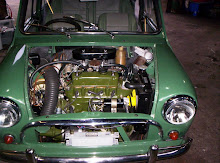
When the Austin Seven and Morris Mini-Minor were introduced in 1959, after eight years of design and development, they caused a sensation in the motoring world for the new B.M.C. Minis bristled with unconventional ideas, but were nevertheless essentially practical in conception. Soon the original Austin and Morris Minis were joined by the Wolseley Hornet and the Riley Elf, together with the redoubtable Cooper and Cooper "S" versions which immediately established themselves as giant-killers in the racing and competition worlds.
In October 1967 came the Mini "1000" Mark II models, with 998 c.c. engines, and in October 1969, ten years and two million Minis after the introduction of the original cars, the more refined and comfortable Clubman and 1275 GT models. These were followed, in November 1969, by two new "basic" Minis—the 850 and the 1000—which retained the old bodyshell but incorporated the wind-up windows, concealed hinges and the negative-earth electric system of the Clubman.
The Mini 850, 1000, Clubman, Clubman Estate, 1275 GT and the Cooper "S" therefore comprised the complete Mini range, the Austin, Morris, Wolseley and Riley variants being discontinued and the cars being known simply as Minis in their own right.
To what do the Minis owe their astonishing success? It was their designer, Alec Issigonis, who best summed it up when he remarked, in effect, "We have deliberately made the cars very small outside, because we have found new ways of making them very large inside."
How was this done, and how does it affect the owner who proposes to carry out as much maintenance as possible in the home garage? First, there is the arrangement of the combined engine and transmission unit transversely across the front of the car. Besides saving a great deal of space, this has rendered all the usual items that require attention (except possibly the ignition distributor) unusually accessible; the owner should have no difficulty in carrying out normal adjustments and all work short of a major overhaul (which calls for removal of the engine).
Admittedly the ignition equipment, being mounted at the front of the engine without protection from a radiator, is liable, on earlier models, to be swamped by a bow wave if a water-splash is negotiated too enthusiastically, and cutting-out of the ignition can also occur when driving in heavy rain. Simple methods of waterproofing the ignition system are, however, discussed in Chapter 7. The engine and transmission assembly share a common supply of oil. Instead of having to check and top-up three oil levels, the work is confined to checking the level on the usual engine dipstick and adding fresh oil through the filler on the valve cover. A similar saving in time and trouble applies, of course, when it is necessary to drain the oil.
Notice, also, that air is forced through the side-mounted radiator from the engine side, emerging by way of the nearside wheel arch, which means that the engine is not surrounded by preheated air .The technically-minded reader will appreciate that this might lead to carburettor icing in cold weather but will note that this can be taken care of, on most models, by positioning the inlet to the air cleaner close to the exhaust manifold. A pre-heated air intake does, of course, result in the loss of a small amount of power under full-throttle conditions, but this is more than compensated for by improved flexibility and better fuel consumption over a wide range of running conditions and in hot weather the intake can be swung away from the manifold.
Again there is evidence of the combination of technical and practical considerations in the use of hollow rubber cones as suspension units instead of steel coil or leaf springs. Rubber springs not only have excellent self-damping properties, giving a particularly good "ride," but require no lubrication and cannot develop squeaks or broken leaves! The Hydro-lastic suspension fitted to later cars, which is described in Chapter 9, takes the principle a stage further by interconnecting the front and rear suspension units, giving a level, pitch-free ride that is outstanding for such a small vehicle.
One could continue to point out examples of the way in which technical advantages have been combined with practical features throughout the car. It is necessary, however, to turn now to a brief description of the functioning of the various instruments and controls, followed by notes on the handling characteristics of the various models. The information is intended mainly for the benefit of an owner who is anxious to get the best from his car; it does not come into the category of elementary driving instruction, as this is a subject which is obviously the province of a fully-qualified instructor.
Sunday, 18 October 2009
Getting to know your car
Labels: car, cooper, equipment, getting, know, mini, radiator, suspansion, transmission, waterproofing
Posted by Info Mini Cars at 04:52 0 comments
Assessing Performance and Fuel Consumption
Few subjects are more likely to provoke argument among rival owners than claims in respect of maximum and average speeds and m.p.g. figures. The only practical course is to tabulate some average figures which should be within the capabilities of a car that is in tip-top condition and on which the ignition and carburettor settings have been adjusted to a nicety, as described in other chapters of this book. These will be found in the Appendix.
In published road tests one often sees the 0 to 50 m.p.h. or 0 to 60 m.p.h. time quoted as a basis for comparison; but to obtain a really low figure in a standing-start test entails quite brutal engagement of the clutch at high engine revs and "snatching" of the gear changes—treatment which competition drivers accept as inevitable but which a considerate owner would hesitate to adopt. A less drastic test, and one which will give a reliable picture of the overall efficiency of the car, is to time the acceleration in third and top gears, from, say 20 to 40 m.p.h. or from 30 to 50 m.p.h.
As one would expect, a small car is appreciably livelier when only the driver is on board, as compared with a full load of passengers and holiday luggage. As a compromise, therefore, the figures given on page 147 relate to the performance that can be expected when a driver and one passenger are carried; the same applies in the case of the van, when it seems logical to assess the performance of this vehicle when carrying about half its maximum load.
The maximum speeds quoted for the indirect gears are the ultimate that can be reached, as opposed to the rather lower speeds at which one would normally change up during ordinary driving. Their chief value is an occasional check on engine condition; if the maximum obtainable in, say, second gear, falls appreciably short of the figure quoted, it is logical to suspect weak valve springs, sticking or burnt valves, retarded ignition timing or inefficient sparking plugs—faults which can be present even when an engine is otherwise in good mechanical condition and which can, fortunately, be put right quite easily by a practical owner.
Two further points deserve mention, before leaving the subject of performance. In the first place, the true maximum speed is always difficult to assess accurately. The best plan is to take the average of a series of runs in both directions over the same stretch of road, in order to cancel out the effects of wind and gradient. It is even more difficult to arrive at a true assessment of fuel consumption, as this can vary by as much as 5 m.p.g. below or 10 m.p.g. above the figures quoted, depending on road and traffic conditions, the load carried, the tyre pressures and the manner in which the car is driven.
Under most conditions, the car behaves quite well on ''mixture" grades of petrol, premium grades being an unnecessary luxury except during long, fairly fast runs in hot weather and when the car is heavily laden. The better grade of fuel will then tend to suppress any "pinking." If a "regular" grade must be used, an alternative ignition distributor is available which has a modified ignition-advance curve.
Labels: assessing, capabilities, consumption, cooper, deserve, figures, fuel, gears, maximum, mention, mini, performance, road, tests
Posted by Info Mini Cars at 04:46 0 comments