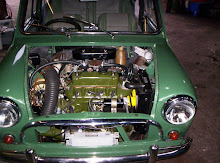
The controller starts by the lack of suitable data "to behave funny. (Humor who can laugh at such jokes about) most often jokes comment on this non-circular, or to a high idle, spontaneous death of the motor, buck, stuttering, misfiring, popping in the air filter housing, poor throttle response in low etc. pp. He also flooded usually hopelessly in which soot cloud from the exhaust and high fuel consumption while poorer performance leads to.
If you now conduct your minis in the list find again that would be the vacuum hoses a very hot tip.
What breaks?
It is mostly tips, the hoses and tear or by the ever-hot environment caused by old age begin to crumble. The hoses themselves are too brittle to get holes / cracks or already rendered unusable by kinks. If no external damages are, there remains the possibility that they are blocked simply expand (if working with compressed air will blow out completely before the tubes!). The hoses are flexible, although limited, but not rubber - that is to carefully work around unfortunately. In rare cases, the case of petrol leaking or overflowing offender, except to say, eight have not. If it is filled with gasoline, it can be expanded and freigeschüttelt. This requires quite a bit of patience.
Saturday, 17 April 2010
The symptoms or: Trouble Shooting
The "hierarchy"
Let's get the yellow hose to the snorkel. It connects the valve with the ThermAC ThermAC switch. The valve is used during a cold start to the fact that as soon as possible to the engine block pre-heated by air drawn in is to rapidly provide proper exhaust emissions. How the switch works exactly, I do not know, but I think it can, depending on the temperature (should be a bi-metal switch) be something of the pressure valve in the snorkel through to fill this order - if necessary. The switch should operate in both directions, Wierum the hoses are connected not have to worry. (If not please contradict! Bin as well versed soo not.)
ThermAC switch from the red hose goes to the intake manifold. (Photos from the engine coming soon. As long as simply hope that the old bottles are still there to hinzuhangeln around.)
From there is the short hose (in black / white) for connection to the gas trap. The petrol is the case, held by a bracket on the fire wall (separation between the engine and passenger compartment) to the left / behind the air box. Remove the Lufi best, makes it easier to work a lot easier.
The connections are designed so that a "reversed polarity" is almost impossible (but "is not" is not, therefore, to note that the management ECU ran to the green connector to be! ). The long, green-coded cable leads for connection to the underside of the ECU next to the connector of the engine wiring harness.
Sunday, 18 October 2009
Getting to know your car
When the Austin Seven and Morris Mini-Minor were introduced in 1959, after eight years of design and development, they caused a sensation in the motoring world for the new B.M.C. Minis bristled with unconventional ideas, but were nevertheless essentially practical in conception. Soon the original Austin and Morris Minis were joined by the Wolseley Hornet and the Riley Elf, together with the redoubtable Cooper and Cooper "S" versions which immediately established themselves as giant-killers in the racing and competition worlds.
In October 1967 came the Mini "1000" Mark II models, with 998 c.c. engines, and in October 1969, ten years and two million Minis after the introduction of the original cars, the more refined and comfortable Clubman and 1275 GT models. These were followed, in November 1969, by two new "basic" Minis—the 850 and the 1000—which retained the old bodyshell but incorporated the wind-up windows, concealed hinges and the negative-earth electric system of the Clubman.
The Mini 850, 1000, Clubman, Clubman Estate, 1275 GT and the Cooper "S" therefore comprised the complete Mini range, the Austin, Morris, Wolseley and Riley variants being discontinued and the cars being known simply as Minis in their own right.
To what do the Minis owe their astonishing success? It was their designer, Alec Issigonis, who best summed it up when he remarked, in effect, "We have deliberately made the cars very small outside, because we have found new ways of making them very large inside."
How was this done, and how does it affect the owner who proposes to carry out as much maintenance as possible in the home garage? First, there is the arrangement of the combined engine and transmission unit transversely across the front of the car. Besides saving a great deal of space, this has rendered all the usual items that require attention (except possibly the ignition distributor) unusually accessible; the owner should have no difficulty in carrying out normal adjustments and all work short of a major overhaul (which calls for removal of the engine).
Admittedly the ignition equipment, being mounted at the front of the engine without protection from a radiator, is liable, on earlier models, to be swamped by a bow wave if a water-splash is negotiated too enthusiastically, and cutting-out of the ignition can also occur when driving in heavy rain. Simple methods of waterproofing the ignition system are, however, discussed in Chapter 7. The engine and transmission assembly share a common supply of oil. Instead of having to check and top-up three oil levels, the work is confined to checking the level on the usual engine dipstick and adding fresh oil through the filler on the valve cover. A similar saving in time and trouble applies, of course, when it is necessary to drain the oil.
Notice, also, that air is forced through the side-mounted radiator from the engine side, emerging by way of the nearside wheel arch, which means that the engine is not surrounded by preheated air .The technically-minded reader will appreciate that this might lead to carburettor icing in cold weather but will note that this can be taken care of, on most models, by positioning the inlet to the air cleaner close to the exhaust manifold. A pre-heated air intake does, of course, result in the loss of a small amount of power under full-throttle conditions, but this is more than compensated for by improved flexibility and better fuel consumption over a wide range of running conditions and in hot weather the intake can be swung away from the manifold.
Again there is evidence of the combination of technical and practical considerations in the use of hollow rubber cones as suspension units instead of steel coil or leaf springs. Rubber springs not only have excellent self-damping properties, giving a particularly good "ride," but require no lubrication and cannot develop squeaks or broken leaves! The Hydro-lastic suspension fitted to later cars, which is described in Chapter 9, takes the principle a stage further by interconnecting the front and rear suspension units, giving a level, pitch-free ride that is outstanding for such a small vehicle.
One could continue to point out examples of the way in which technical advantages have been combined with practical features throughout the car. It is necessary, however, to turn now to a brief description of the functioning of the various instruments and controls, followed by notes on the handling characteristics of the various models. The information is intended mainly for the benefit of an owner who is anxious to get the best from his car; it does not come into the category of elementary driving instruction, as this is a subject which is obviously the province of a fully-qualified instructor.
Towing the Car
The car should never be towed with the front wheels on the ground if a transmission fault is suspected. Garage assistance should be obtained as it is necessary to lift the front end of the vehicle on a suitable towing rig. In other cases the car can be towed normally but the selector must be at N and the ignition should, of course, be switched off.
The Automatic-transmission Models
The automatic transmission which is available on the Austin and Morris Minis provides two-pedal, fully-automatic motoring or complete manual control of the gears, at the choice of the driver. It is particularly well suited to the Mini, since it gives four gear ratios instead of the two or three provided by most other types of automatic transmission. A hydraulic torque converter replaces the clutch and ensures a very smooth take-up of the drive from a standstill and when changing gear.
Driving the "automatic" Mini is delightfully simple if the gear lever is moved to the D position, after starting the engine with the lever at N (an automatic cut-out ensures that the starter mechanism can operate only when the selector is at Neutral). With D or Drive engaged, the trans-mission will change up at speeds which depend on the amount of throttle opening, but the maximum engine revs are limited by a governor in the transmission to the equivalent of about 22 m.p.h. in first gear, 34 m.p.h, in second, and 50 m.p.h. in third.
When maximum acceleration is required, a "kick-down" switch which comes into action at the extreme limit of the throttle-pedal travel will engage the next lowest gear, the maximum speed limits for a kick-down change being approximately 17, 28 and 40 m.p.h. in first, second and third gears respectively.
Probably the most attractive feature of the transmission for the keen driver, however, is the fact that downward changes can be made instantly and very smoothly simply by moving the gear lever to the appropriate position. A "zig-zag" between the second and third gear positions acts as a stop when changing from top to third, preventing accidental engage¬ment of second gear, which might over-speed the engine. The main point to remember, in fact, when controlling the gearbox manually, is not to change down at a road speed which is above the safe engine speed for the next lowest gear. The limits are 50 m.p.h. in third gear and 40 m.p.h. in second gear.
The third feature of the transmission is that any gear can be selected and retained—even top gear when starting from rest. The torque con¬verter will take up the drive smoothly and progressively and the car can be allowed to glide along quietly in traffic, without excessive gear changing and high engine revs. Since the kick-down is operative only when the lever is at D, full throttle can be used without causing a downward change when any of the other gear positions has been selected.
It will be seen that both the beginner and the enthusiast are admirably catered for by this transmission and if you are contemplating the purchase of a used model the higher cost of an "automatic" Mini would probably be more than justified.
Engine and Transmission Lubrication
On conventional cars the engine oil has only to lubricate the engine itself. The gearbox and the final-drive gears in the rear axle have their own supplies of lubricant which, unlike the engine oil, are not subjected to extremes of heat, dilution by condensed fuel and contamination by carbon particles and by acid moisture. On the Minis, however, the engine, "gearbox" and final-drive gears share a common supply of oil, since all the gears and the differential are carried in the crankcase beneath the crankshaft.
It should not be necessary to emphasize, therefore, that "cheap" oils are likely to be the most expensive in the long run. Similarly, any temptation to delay oil changes beyond the recommended mileage is likely to result, sooner or later, in "expensive noises."
This is particularly important when an automatic transmission is fitted. Other types of automatic gearboxes normally call for the use of a special fluid but extensive tests have shown that normal engine oil can be used satisfactorily in the Mini automatic transmission provided that the oil is changed regularly at 3,000-mile intervals and that the oil filter is renewed at least at 6,000-mile intervals and more frequently if the warning light glows. After the specified mileage, changes begin to take place in the engine oil which alter the friction characteristics of the clutches and epicyclic brake bands in the transmission, upsetting the smooth operation of these units.
Owners of new Minis are sometimes worried by heavy oil consumption during the first few thousand miles. Oil may disappear at the rate of a pint in every 150 miles but experience has shown that after about 3,000 miles the piston rings should have bedded-in and the consumption should drop to a much more reasonable figure. By the time that about 5,000 miles have accumulated, for example, it should not exceed about 500 miles to the pint, although Mini-Cooper engines arc rather more thirsty if they are driven hard. Early Coopers, incidentally, gained a reputation for very heavy oil consumption but modifications which were incorporated in later versions reduced their appetite to a more acceptable figure.
Owing to the fact that the engine is not shielded by a warm radiator from the flow of air through the front grille, a good deal of sludge tends to form on the valve rocker gear and inside the rocker cover. This can be prevented by drilling two ,?, in. holes in the oil filler cap; but do not do this if a special crankcase ventilation system is fitted . It also helps to blank off the grille during the winter months.
Saturday, 17 October 2009
Transmission Couplings
The universal joints at each end of the two drive shafts should be checked during the 6,000-mile service. The rubber couplings at the inner end of the shaft may fail within 5,000-6,000 miles if oil is allowed to leak on to them, but can have a life of upwards of 30,000 miles if they are kept free from oil and the U-bolts are correctly tensioned. The self-locking nuts on the U-bolts should be tightened until two threads protrude. If they have been too slack or too tight for any length of time, the rubber cross-pieces in the couplings will have been damaged and should be renewed. It is as well to renew the self-locking nuts at the same time, and as the new bolts are quite cheap, it will do no harm to replace these also.
Faults in the couplings will cause knocks or vibration when starting from a standstill or when the wheels are turned towards full lock. The outer joints, which are of the mechanical type, can develop a knock when wear begins to develop, but provided that it occurs only towards full lock,it is usually safe to assume that the joints will still have a good deal of useful life left in them. Make sure, however, that the rubber boots over the mechanical joints and the splined connexions are in sound condition. It is not difficult to fit new boots after uncoupling the U-bolts on the rubber joint but it is essential to pack the splines and joints with the correct grease. For the mechanical joints, use only Duckham's Molybentone grease, B.M.C. Part No. AKF1457. The only grease approved for the sliding splines is Duckham's Lammol grease, Part No. 97H2611.

This cooling system thermostat is in good condition. The water-control valve (1) is closed and the bellows (2) undamaged