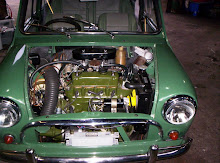
If the battery has insufficient charge to turn the engine over with the starter motor but is providing sufficient current to operate the ignition system, it is not possible to start the car in the usual way by enlisting the aid of friends to push it at a relatively low speed with top gear engaged, since the slip in the torque converter will be1 sufficient to prevent the engine rotating. It will be necessary to tow the car at a speed of about 20 m.p.h. before the transmission will drive the engine. If this can be done, the drill is to set the mixture control, if necessary, switch on the ignition and select second gear manually when a speed of 20 m.p.h. is reached. Then depress the accelerator sufficiently to enable the engine to start. If the engine is new and has not completed its running-in period, however, a road speed of about 30 m.p.h. must be reached and D must be selected.
Showing posts with label ignition. Show all posts
Showing posts with label ignition. Show all posts
Sunday, 18 October 2009
The Instruments and Controls
If the driving belt appears to be sound and correctly tensioned, failure of the lamp to be extinguished indicates a fault in the charging circuit, either in the dynamo, control box or wiring, which should be investigated at the earliest possible opportunity by a specialist. The reserve of current stored in the battery can be exhausted comparatively quickly, particularly when driving at night even if one forgoes the luxury of keeping the heater or radio in operation.
If the light does not glow when the ignition is first switched on, it is obviously essential to check the bulb in the warning lamp and renew it if necessary, or to trace and put right the fault in the circuit.

Fig. 2. The oil-pressure-operated warning light switch (1). The micrometer ignition-timing adjuster (2) is also shown
Subscribe to:
Posts (Atom)